The Wolves Move Their Pups to a Summer Den
Never Cry WolfThe Wolves Move Their Pups to a Summer Den is a seasonal change in the wolf family’s life: Angeline carries each pup from the old den to a new refuge where the growing litter can drink, move about, and begin learning beyond the nursery. The transfer briefly alarms the watching narrator, who mistakes the family’s disappearance for a possible response to his observation. Ootek’s explanation recasts it as a normal stage of wolf pup-rearing, governed by the youngsters’ changing needs rather than by the human observer’s presence.
Restlessness Before the Move
During the third week of June, Angeline became increasingly restless at the den. When George and Uncle Albert set out for their evening hunts, she began accompanying them partway. At first she went only about a hundred yards; on one occasion she travelled a quarter of a mile before turning back. Her growing excursions marked a change from the close demands of caring for the pups, though the observation does not suggest that she had stopped tending them.
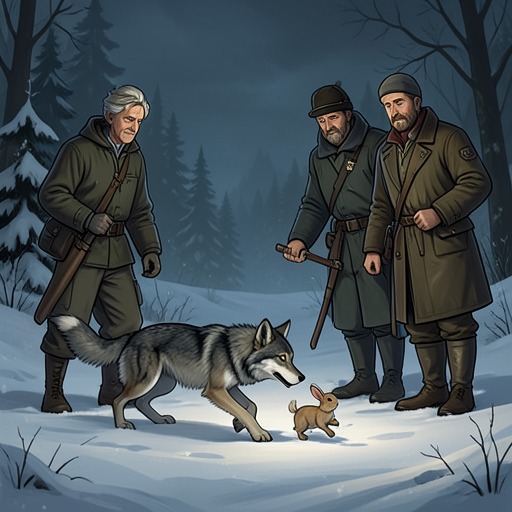
George appeared eager for her to range farther with him. He had tried for weeks to draw her into the wolves’ night-long journeys. On one evening he delayed leaving for an hour after Uncle Albert had already gone ahead. During that hour George made eight journeys between the lookout ridge and the nursery knoll, each time approaching Angeline and then setting off hopefully toward the trail. Each time she remained with the pups, he returned to the ridge and waited. When he eventually left alone, his lowered head and tail gave the narrator an unmistakable impression of disappointment.
On June 23, Angeline joined George for the evening departure after the wolves’ pre-hunt gathering. Uncle Albert stayed behind at the den with the pups. The next morning, shortly before nine, George and Uncle Albert appeared on the esker without Angeline. Their pacing, repeated sniffing, and pauses to scan the landscape differed from their ordinary behavior. George took the high point and watched east and south; Uncle Albert moved north along the ridge, then settled facing the western plains. The narrator read their watchfulness alongside Angeline’s absence and began to fear that something had happened to her. His concern was personal as well as observational: he had not understood until then how attached he had become to her.
The Transfer
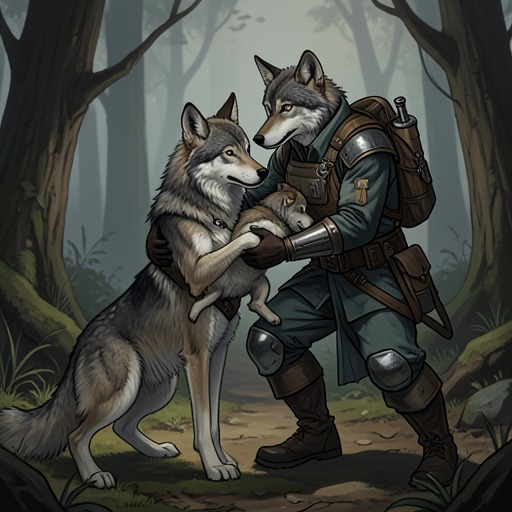
Angeline resolved the immediate uncertainty herself. As the narrator looked through his telescope, she emerged from the den carrying a pup. She crossed the esker diagonally and disappeared into a small stand of spruce. The pup was a substantial burden, estimated by the observer at ten or fifteen pounds, yet Angeline made the journey briskly. About fifteen minutes later she returned for another. By ten o’clock she had carried the last pup away.
The two males had remained at their separate lookout points while Angeline made the repeated trips. After the final transfer, both abandoned their positions and followed her. Their movements led the narrator to conclude that they had been keeping watch during the relocation. From his vantage point, however, the family’s departure left an empty landscape and no visible explanation. He feared that his presence had disturbed the wolves so seriously that they had been forced to abandon the old den; believing pursuit could make matters worse, he went back to the cabin to consult Ootek instead of following them.
Why the Pups Needed a New Home
Ootek reassured him that moving the pups was a normal occurrence at this point in the year. The litter had been weaned, and the old den had no nearby water supply. The pups therefore needed a place where they could drink without depending on their mother. They had also grown too large for the original den to contain them comfortably. These practical changes made the familiar nursery unsuitable just as the pups were ready for a different kind of upbringing.
The transition also had a developmental purpose. Ootek explained that the pups were no longer at the stage of living in a hole in the ground, but were still too young to travel with their parents. Mike interpreted this explanation for the narrator: the family would settle the youngsters somewhere with room to move and opportunities to learn, while keeping them protected. The move was thus neither a sudden flight nor a break in family care. It shifted the pups from a confined birth den to an intermediate home suited to their growing independence.
The Summer Den
Ootek and Mike knew the new site, and the following day the narrator moved the observation tent to a position partly overlooking it. The summer den lay half a mile from the old one in a narrow, truncated ravine. Its large boulders had broken from the cliff walls through frost action, and a small stream ran through the ravine. Nearby grassy marsh supported meadow mice, giving the pups a setting in which they could encounter the beginnings of hunting.
The ravine’s difficult entrance and exit also helped contain the litter: the climb was too steep for the young pups, reducing the chance that they would wander away. At the same time, they had grown large enough to hold their own against the other substantial local carnivores, foxes and hawks. Water, room, food opportunities, and natural limits on wandering all came together at the new site. The move did not simply exchange one shelter for another; it placed the pups in an environment fitted to the next stage of their development.
Observation and Significance
The episode distinguishes what the narrator sees from what he can initially understand. He witnesses Angeline’s repeated journeys and the males’ vigilant positions, but first interprets the empty den through his own fear that his research has driven the wolves away. Ootek’s local knowledge supplies the seasonal context that the telescope cannot: the pups have been weaned, the old site lacks water, and the family’s relocation is part of their education. After allowing the wolves time to settle at the summer den, the narrator spends the next night at the cabin catching up on his notes rather than immediately resuming close observation.
The family’s coordinated actions make the transfer legible without turning it into a human-style drama. Angeline carries the litter; George and Uncle Albert keep watch and follow once the move is complete; and the pups arrive at a place where they can begin to explore while remaining protected. For the narrator, the change is both a correction of his mistaken fear and a concrete example of how wolf family life adapts to the needs of growing young. The den is not a fixed home but one stage in a sequence of care, with the summer ravine opening onto water, movement, and early lessons in hunting.